Premium Link-Building Services
Explore premium link-building options to boost your online visibility.
Explore premium link-building options to boost your online visibility.
By the AI SEO Agency New York Editorial Team
Your team has probably adopted several AI tools without anyone asking legal. Then a headline makes a claim no human verified, and leadership wants a policy — fast.
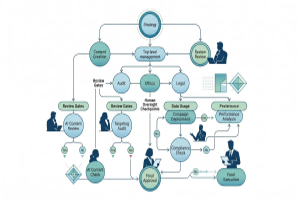
That is common because most companies treat AI governance marketing as a procurement afterthought. The real work is not selecting tools. It is building protocols for human review, bias detection, output attribution, accuracy verification, and vendor accountability. Responsible AI adoption demands documented review workflows and accountability structures — not just prompt engineering and software licenses. Without those elements, you are procuring risk, not managing it.
Research from Manchester Metropolitan University finds that businesses adopting AI tools without adapting processes gain no competitive advantage — they merely “automate existing, inefficient processes to go a bit faster.” The researchers advocate shifting from adoption to adaptation: changing workflows and team behaviors to exploit AI responsibly.
The study documents a “trust-building journey” among SMEs, where firms that implemented AI through structured programs reported 86% productivity gains and 63% cost reductions — but only when human oversight was embedded from the start. Ad hoc usage produced unchecked claims and compliance exposure.
A study coauthored by César Zamudio, Ph.D., at Virginia Commonwealth University and published in the Journal of Retailing and Consumer Services found that AI-generated imagery in service advertising affects consumer trust in specific, measurable ways. When AI generates backgrounds and environments but real photographs depict service providers, trust remains intact. When AI generates the people, trust drops.
The lesson for marketing governance is precise: disclosure and selective use matter. “Use AI for settings, not people,” Zamudio advises. A governance framework should codify which visual and textual elements may be AI-generated, which require human creation, and how disclosures are presented. These questions sit at the center of AI marketing ethics — they are not technical decisions alone, but trust decisions with commercial consequences.
Google Search Central has clarified that its systems do not penalize AI-generated content outright. What matters is whether content demonstrates Experience, Expertise, Authoritativeness, and Trustworthiness — the E-E-A-T framework. AI-assisted content can perform well if it is accurate, attributed, and genuinely helpful.
This creates a governance imperative around verification. Marketing teams need fact-checking protocols and editorial review gates that confirm outputs meet Google’s quality standards. AI-generated content that spreads misinformation risks visibility losses — not because it is AI-generated, but because it fails the people-first test. See Google’s guidance on creating helpful, people-first content.
Score each item 0 (not implemented), 1 (partial), or 2 (fully operational). A total below 12 indicates significant exposure.
#
Governance Element
0 / 1 / 2
1
Human Review Protocol — All AI-generated content reviewed before publication
___
2
Accuracy Verification — Factual claims verified against primary sources
___
3
Bias Detection — Outputs screened for demographic or representational bias
___
4
Output Attribution — AI-generated content logged and labeled internally
___
5
Disclosure Standards — External AI content follows published disclosure rules
___
6
Vendor Accountability — Vendors evaluated for data handling and compliance
___
7
Data Privacy Controls — Customer data not entered into public AI without clearance
___
8
Escalation Path — Clear process for reporting AI-related errors or concerns
___
Scoring: 16 = strong; 12–15 = gaps to address; below 12 = suspend public AI content until controls are in place.
This checklist assumes a corporate structure with legal and compliance functions available. Startups with no legal resource, solo operators, and teams in highly regulated industries (healthcare, financial services) will need additional controls.
The framework focuses on marketing-specific AI use — content generation, imagery, ad targeting — and does not address AI in hiring, lending, or medical applications where regulatory requirements are stricter. If your organization faces the EU AI Act or federal procurement rules, align governance with the NIST AI Risk Management Framework, which organizes oversight into Govern, Map, Measure, and Manage functions. AI governance is iterative — your marketing governance should follow the same cycle.
Have your marketing lead and legal representative complete the checklist independently, then compare scores. Disagreement signals an undocumented assumption that needs clarification. Prioritize the lowest-scoring items affecting your highest-volume outputs. Document decisions in a short policy memo, assign owners, and set a 90-day review date. Governance does not need to be complex on day one; it needs to exist.
For organizations building AI marketing capability, our team has published guidance on AI marketing for B2B leaders, the essential skills AI marketing experts bring, and how AI marketing agencies are reshaping delivery. See also our analysis of the 2026 digital marketing landscape and the rise of AI marketing experts.
Who should own AI marketing governance? Marketing owns execution, legal sets boundaries, IT assesses vendor security. One senior marketing lead should be named accountable for compliance decisions.
How often should AI marketing outputs be audited? Spot-check high-volume outputs weekly. Run full governance audits quarterly or whenever you adopt a new AI tool.
Do we need to disclose AI-generated content? Disclosure requirements vary by platform and jurisdiction. The FTC has issued guidance on AI-generated advertising, and some states require labeling. Even where not legally required, selective disclosure often strengthens trust — the VCU research confirms this.
Can we use AI-generated images of people in ads? The VCU study found that AI-generated depictions of service providers reduce consumer trust. Use AI for backgrounds; use real photography for people in relationship-driven industries.
What is the biggest governance mistake? Treating AI governance as a one-time policy document rather than an operational workflow. Governance lives in checklists, review gates, and escalation paths — not in shared drives.
Explore premium link-building options to boost your online visibility.